
STAGECOACH MEMORIES
A sign of past times

When my family briefly moved from Boston’s Back Bay in the early 1960s, we landed in suburban Wayland, a dramatic change from the city streets my brothers and I were used to. A short walk from our home stood the Red Coach Grill, an upscale part of the Howard Johnson’s chain serving steak and seafood. I remember it well because the restaurant parking lot is where we caught the school bus.
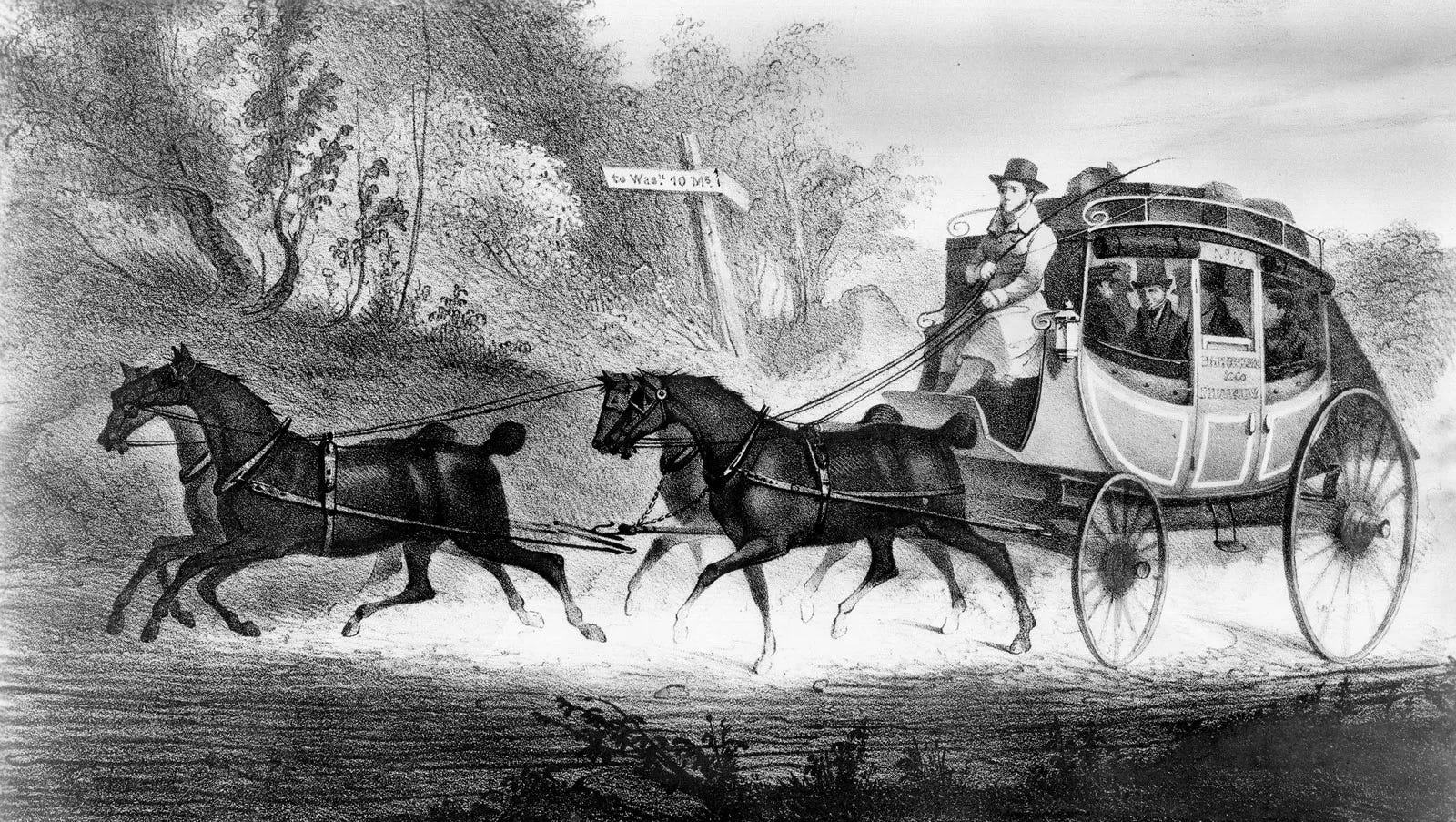
I didn’t think much of it at the time but atop the restaurant sign was a stagecoach, not surprisingly, red. I’ve since found out that it was a replica of the Concord Coach, a stagecoach used across the country created by the Abbot-Downing Co. of Concord, N.H.
Out here in Illinois where, in the early 1800s, as one historian put it, the wilderness between towns like Peoria and Galena was “vast and unbroken,” it was the stagecoach that served the hardy traveler--and delivered the mail. Native Americans might differ with that vast wilderness description but the stagecoach’s heyday in the 1830s and 1840s came about while Illinois towns were still few and far-between.
“The stage business was not for the faint of heart at the best of times, given its cutthroat competition and the politics involved with securing the all-important mail contracts,” noted Roger Matile in his account on “stagecoach kings,” John Frink and Martin Walker, for the Journal of the Illinois State Historical Society (summer, 2002).
Frink and Walker “came to dominate virtually all the stagecoach business in Illinois, Michigan, Wisconsin, Iowa, Indiana and Missouri,” stated Matile, describing a partnership that ran from 1840 to 1856.
Chances are if you traveled on the Frink-Walker line, you rode in a Concord Coach, the same kind that I remember seeing atop the restaurant sign. Incidentally, while the Howard Johnson firm is no more, that restaurant in Wayland remains in business today, now known simply as the Coach Grill.
Reviews of the Concord Coach reveal conflicting opinions. While Mark Twain described riding in one as “a cradle on wheels,” other critics were far less forgiving. Other descriptions cited the coach being top-heavy, narrow and uncomfortable. But they were sturdy. They had to be with the rough roads, ravines and natural obstacles faced on the trail.
Frink, whose father was involved with the stagecoach business in the East, moved with his family to Chicago in 1836. His life (he died in 1858) is testimony to how transportation evolved in the 1800s. Not only was Frink a wheeler-dealer when it came to the stagecoach business, going through a number of partners before hooking up with Martin Walker, but he also invested in steamboats, another major player of the era, and served on the board of a number of railroad companies including the Peoria & Oquawaka Rail Road (later to become the Toledo, Peoria & Western) and the Peoria & Bureau Valley Railroad.
Henri Detweiller learned the ropes of riverboating when hired by Frink in 1840 as a pilot trainee. When he left Frink’s employ in 1844, he went on to riverboat and icemaking fame on the Illinois River. Today Detweiller Park stands in Peoria in his honor.
While the period when stagecoaches were active in this country was comparatively short, they made the mark. In many cases, it was a postmark. Mail delivery made up 30 percent or more of the revenue on most stagecoach operations. When coaches neared a post office, drivers blew a horn to signal the mail’s arrival, encouraging the public to get to the post office to see what mail, magazines and newspapers might have been delivered, noted Matile.
Matile points out that while railroad growth and the completion of the Illinois & Michigan Canal (1848) forced the stagecoach business to decline—not just in Illinois but across the Midwest, he added “The coaches continued to provide faithful, if uncomfortable, service west of the Mississippi right up to the 20th century. It was an enviable record in anyone’s book.”
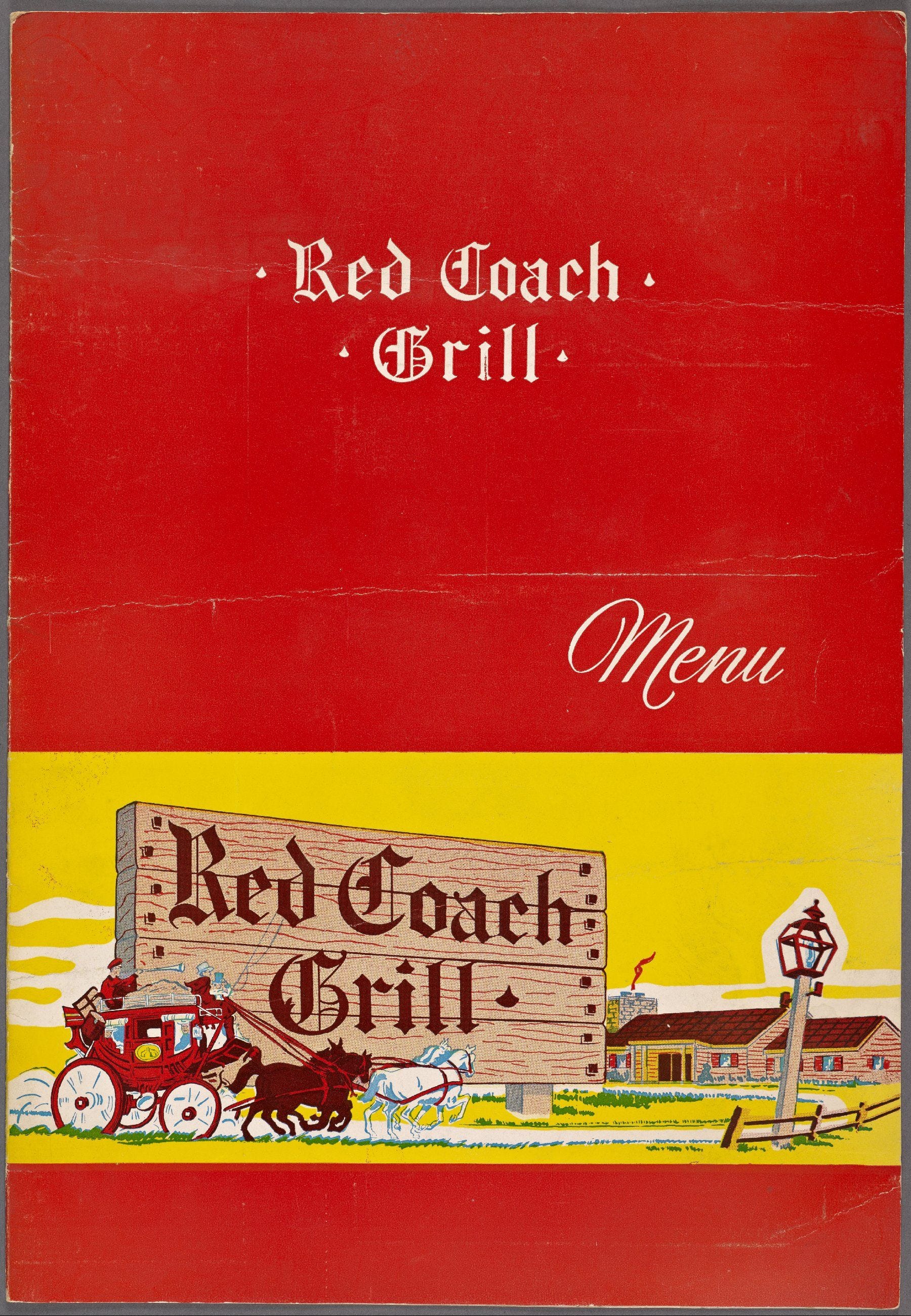
We only went to the Red Coach Grill when my father had something to celebrate (new job, news about his invention, etc.) We didn't go very often.